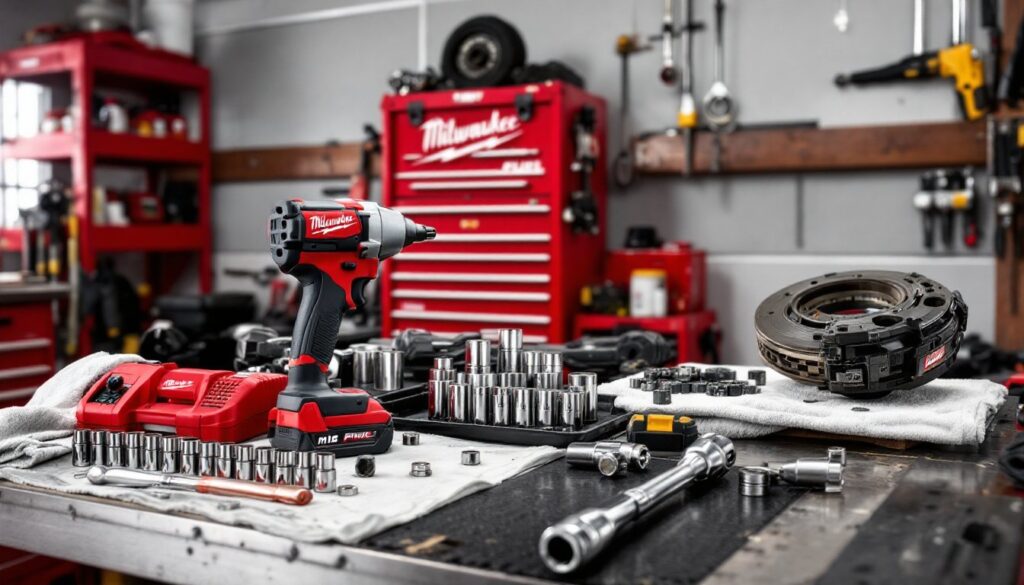
Milwaukee has built a reputation for producing mechanic tools that can handle both professional shop environments and demanding home garage projects. Their lineup spans from hand tools engineered for torque and durability to battery-powered impact wrenches that rival pneumatic models. For DIYers tackling brake jobs, engine work, or routine maintenance, Milwaukee offers a compelling combination of build quality and innovation, though understanding which tools deliver the best value requires a closer look at what sets them apart from the competition.
Table of Contents
ToggleKey Takeaways
- Milwaukee mechanic tools stand out through engineering innovations like four-flat ratchet designs that reduce fastener rounding and dual-hole SHOCKWAVE impact-rated sockets that outlast standard models.
- The M18 FUEL battery-powered platform delivers 1,000 ft-lbs of torque on high-torque impact wrenches, rivaling pneumatic models while eliminating the need for an air compressor.
- Essential Milwaukee mechanic tool socket sets include 1/4-inch, 3/8-inch, and 1/2-inch drives with both shallow and deep sockets to handle fasteners across engines, chassis, and suspension components.
- For DIYers, battery-powered Milwaukee tools offer superior portability and consistent performance across personal vehicle work, while pneumatic options remain cost-effective if you already own a compressor.
- Milwaukee’s PACKOUT modular storage system provides customizable, weather-sealed organization for growing tool collections with excellent portability but limited security compared to traditional tool chests.
Why Milwaukee Stands Out in the Mechanic Tool Market
Milwaukee’s mechanic tools differentiate themselves through a few key engineering decisions that matter when you’re under a vehicle or working in tight engine bays.
First, their ratchets and sockets use a four-flat design that reduces rounding on fasteners, a real problem with cheaper chrome vanadium sets. The teeth count on their ratchets typically runs 90 to 120 teeth, which translates to a smaller swing arc (as little as 3 degrees on their high-tooth models). That matters when you’re fighting for clearance around suspension components or valve covers.
Their SHOCKWAVE impact-rated sockets feature a dual-hole design and proprietary steel that Milwaukee claims reduces wear on both the socket and fastener. Independent testing shows these hold up better than standard impact sockets under repeated high-torque applications, though they cost 20-30% more than comparable sets.
Milwaukee also invests heavily in their M18 FUEL platform, which uses brushless motors and RedLithium batteries. The torque output on their M18 impact wrenches ranges from 220 ft-lbs on compact models to over 1,000 ft-lbs on their high-torque units, enough to break loose lug nuts, axle bolts, and most suspension fasteners without reaching for a breaker bar.
The brand backs most mechanic hand tools with a limited lifetime warranty, and their battery-powered tools carry a 3-year warranty on the tool and 2-year warranty on batteries. That’s standard for professional-grade tools but better than most entry-level brands.
Essential Milwaukee Mechanic Tools Every DIYer Should Own
Socket Sets and Ratchets
A solid socket set forms the foundation of any mechanic’s toolkit. Milwaukee’s 1/4-inch, 3/8-inch, and 1/2-inch drive sets cover the majority of automotive fasteners you’ll encounter.
The 3/8-inch drive is the workhorse for general engine and chassis work. Milwaukee’s sets typically include both shallow and deep sockets in metric (8mm-19mm) and SAE (1/4″-3/4″) sizes. Deep sockets are essential for reaching recessed bolts on starters, alternators, and exhaust manifolds.
For tight spaces, their 1/4-inch drive handles smaller fasteners on electronics, trim panels, and interior components. The ratchet head on Milwaukee’s 1/4″ models is compact enough to fit in areas where a 3/8″ simply won’t go.
The 1/2-inch drive is necessary for high-torque applications: lug nuts, axle nuts, crankshaft bolts, and suspension work. Milwaukee’s 1/2″ impact sockets are thicker-walled than their hand tool equivalents and designed to absorb the shock from impact wrenches without cracking.
When comparing mechanical workshop tools, look for sets that include extension bars (3″, 6″, and 10″ minimum), a universal joint, and both standard and spark plug sockets. Milwaukee bundles these in their larger sets, which run $150-$400 depending on piece count and storage case quality.
Impact Wrenches and Drivers
Impact wrenches transform jobs that would otherwise require a breaker bar and serious leverage. Milwaukee’s M18 FUEL 1/2″ High-Torque Impact Wrench delivers 1,000 ft-lbs of nut-busting torque and 750 ft-lbs of fastening torque. That’s sufficient for virtually all passenger vehicle work, including stubborn tie rod ends and ball joints.
For general tasks, the M18 FUEL 3/8″ Mid-Torque Impact Wrench offers 250 ft-lbs in a lighter package. It handles brake calipers, engine mounts, and transmission bolts without the heft of a 1/2″ model.
Milwaukee’s M12 FUEL 1/4″ Hex Impact Driver isn’t strictly a mechanic tool, but it’s invaluable for removing trim clips, interior fasteners, and working in confined spaces where a drill or impact wrench won’t fit.
All of these run on Milwaukee’s battery platform, which means one set of batteries works across the entire lineup. The M18 5.0Ah battery provides enough runtime for most home garage projects, while 8.0Ah and 12.0Ah batteries suit professionals doing multiple jobs daily.
Be aware that battery-powered tools add cost upfront. A bare M18 impact wrench runs $200-$300, while a kit with battery and charger costs $350-$450. But once you’re in the ecosystem, additional bare tools are cheaper.
Milwaukee’s Best Tool Storage Solutions for Your Workshop
Milwaukee’s PACKOUT system uses modular, interlocking storage boxes that stack and lock together. Each unit features metal reinforced corners, IP65 weather sealing, and a weight capacity up to 250 lbs depending on the box size.
The system includes rolling toolboxes, stackable organizers, wall-mounted plates, and specialty storage for hand tools. The PACKOUT rolling toolbox serves as the base for most setups, it has 10-inch puncture-resistant wheels and a telescoping handle for moving across a garage or driveway.
Milwaukee also offers wall-mounted PACKOUT racking, which lets you build vertical storage without needing a dedicated tool chest. This works well in smaller garages where floor space is limited.
For hand tools specifically, their 3-drawer toolbox includes removable organizers and fits most ratchet and socket sets. The drawers use ball-bearing slides rated for 100 lbs each, enough for loaded socket trays and heavy wrenches.
Compared to traditional rolling cabinets, PACKOUT is more modular but less secure. There are no locking mechanisms beyond the latches on each box, so it’s not ideal if theft is a concern. But, the portability is unmatched for those who work on vehicles in different locations.
Additional storage options include automotive workshop tools organizers that work well with Milwaukee’s hand tool sets and provide foam inserts for custom layouts.
Battery-Powered vs. Pneumatic: Choosing the Right Milwaukee Tools
The decision between battery-powered and pneumatic (air-powered) tools comes down to portability, power consistency, and existing infrastructure.
Battery-powered advantages:
- No air compressor required, which saves space and eliminates noise
- Portability for roadside repairs or working on vehicles away from the garage
- Consistent torque delivery regardless of hose length or compressor capacity
- No hoses to trip over or manage
Milwaukee’s M18 FUEL impact wrenches match or exceed the performance of 90 PSI pneumatic impacts in most applications. Testing by independent reviewers shows the M18 High-Torque model outperforms many shop-grade air impacts up to 600 ft-lbs.
Pneumatic advantages:
- Lower upfront cost (a quality air impact wrench costs $100-$200 vs. $300+ for Milwaukee’s battery equivalent)
- Unlimited runtime as long as the compressor keeps up
- Lighter tool weight since there’s no battery to carry
- Better for sustained high-torque work like fleet maintenance or heavy equipment
Pneumatic tools require a compressor rated for at least 4-6 CFM at 90 PSI to run most impact wrenches effectively. A quality compressor suitable for mechanic work costs $300-$600, which narrows the price gap when starting from scratch.
For DIYers working on personal vehicles, battery-powered tools make more sense. The convenience and performance justify the cost, and Milwaukee’s battery platform extends to drills, saws, and essential workshop tools that share the same power source.
If you already own an air compressor for painting, inflating tires, or running pneumatic nailers, adding Milwaukee’s pneumatic impact wrenches is cost-effective. Their air-powered models deliver solid performance at a lower price point than their cordless equivalents.
One consideration: battery-powered tools perform slightly worse in cold weather. Lithium-ion batteries lose capacity below 32°F, which can reduce torque output and runtime. If you work in an unheated garage during winter, keep batteries inside until you need them.
Milwaukee also doesn’t currently offer pneumatic versions of all their mechanic tools, their focus has shifted heavily toward battery-powered models. For comprehensive automotive tool lists, you may need to mix brands if you prefer air tools.
Conclusion
Milwaukee mechanic tools deliver professional-grade performance that justifies the premium over entry-level brands. Their socket sets, ratchets, and battery-powered impact wrenches handle demanding automotive work, while the PACKOUT storage system provides modular organization for growing tool collections. Whether choosing battery or pneumatic models, prioritize tools that match the specific jobs you tackle most often, and don’t skip the safety glasses and mechanic gloves.