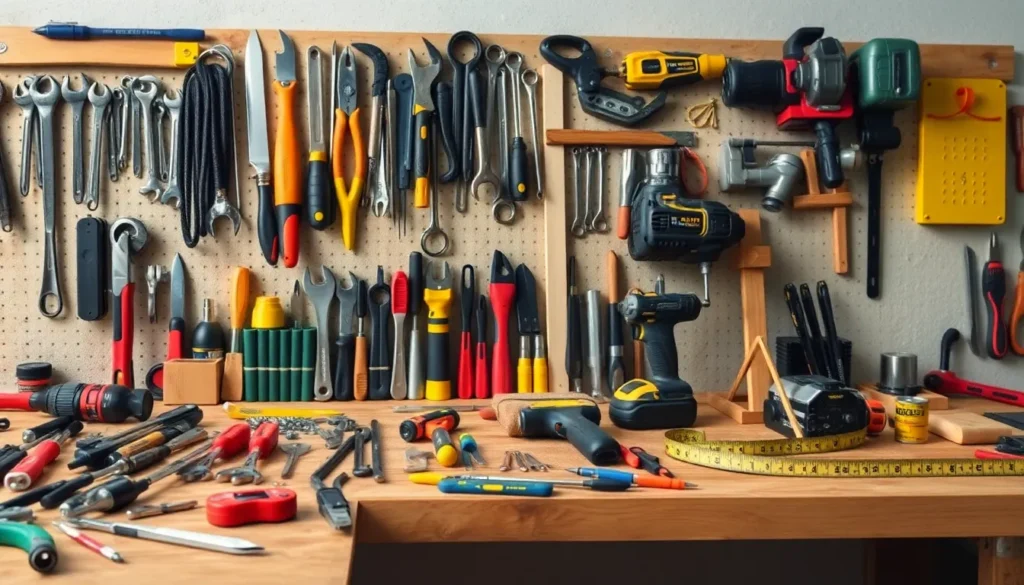
In the world of DIY and home improvement, knowing your tools is like having a secret weapon. Imagine walking into a workshop and confidently naming every tool on the wall—now that’s impressive! From the trusty hammer that’s seen one too many nail mishaps to the mysterious-looking tool that no one knows how to use, understanding workshop tools can turn any novice into a DIY hero.
Table of Contents
ToggleEssential Hand Tools
Understanding essential hand tools facilitates successful DIY and home improvement projects. Familiarity with these tools enhances skills and builds confidence in various tasks.
Screwdrivers
Screwdrivers serve vital functions in assembling and disassembling items. Common types include flathead and Phillips, each designed for specific screw types. Selecting the right screwdriver prevents damage to screws and improves efficiency. A tool set often includes various sizes to accommodate different applications. Proper grip enhances control and reduces slippage during use.
Pliers
Pliers are versatile tools that assist in gripping, twisting, and cutting wires or small objects. Various plier types exist, such as needle-nose, slip-joint, and cutting pliers, each tailored for specific tasks. Needle-nose pliers excel at reaching tight spaces, while slip-joint pliers provide adjustable grip. Proper handling ensures safety and effectiveness during use. Accessories like insulated grips improve comfort and reduce fatigue.
Wrenches
Wrenches are indispensable in mechanical tasks involving nuts and bolts. Types include adjustable, socket, and combination wrenches, each offering unique benefits. Adjustable wrenches allow for various sizes, while socket wrenches speed up the process of loosening or tightening fasteners. Selecting the right wrench for the job prevents slippage and improves torque application. Utilizing proper techniques enhances precision and minimizes the risk of damage.
Power Tools Overview
Power tools play a significant role in improving efficiency and precision in various projects. Familiarity with these tools enhances productivity and quality in DIY and home improvement tasks.
Drills
Drills are essential for creating holes in various materials, including wood, metal, and plastic. Cordless versions offer mobility, making them suitable for outdoor or remote tasks. Hammer drills combine rotation with a hammering action, ideal for tougher materials like brick and concrete. Understanding drill bits is crucial, as specific types cater to different materials and hole sizes. Using the correct drill bit not only ensures efficiency but also minimizes damage to the workpiece.
Saws
Saws are indispensable for cutting materials into desired shapes and sizes. Circular saws excel at making straight cuts in wood, while jigsaws perform curved and intricate cuts. Table saws provide stability and precision, especially for larger projects. A miter saw is beneficial for making angled cuts in trim and molding. Selecting the right saw based on the job requirements significantly impacts the final result.
Sanders
Sanders are vital for finishing surfaces to achieve smooth and polished results. Orbit sanders offer versatility for various materials with their round sanding discs. Belt sanders deliver power for removing material quickly, particularly on large flat areas. Detail sanders cater to small, intricate spaces that require precision. Utilizing the appropriate sandpaper grit enhances the effectiveness of these tools in preparing surfaces for painting or varnishing.
Measuring and Layout Tools
Measuring and layout tools are vital for achieving accuracy in DIY and home improvement projects. Familiarity with these tools improves precision in measurements and layouts.
Tape Measures
Tape measures are indispensable for measuring distance. They come in flexible, retractable forms, which makes them easy to use. Standard lengths usually range from 16 to 25 feet, though specialty tapes can exceed 100 feet. Measuring markings often include fractions, centimeters, and millimeters for versatility. Users can make quick measurements on various materials, such as wood, metal, and drywall, ensuring proper sizing and fit.
Squares
Squares help ensure that cuts and layouts are straight and accurate. Common types include framing squares, speed squares, and carpenter squares. Framing squares are typically 30 inches long and 24 inches wide, useful for checking right angles in framing and layout work. Speed squares are smaller alternatives, measuring generally 7 to 12 inches, allowing quick marking of angles and cuts. Squares improve alignment while cutting materials and ensure consistent angles in construction and assembly tasks.
Levels
Levels are essential for checking the horizontal or vertical alignment of surfaces. Common types include spirit levels and laser levels. Spirit levels often comprise a few inches long, using fluid-filled vials to indicate level positions. Laser levels, on the other hand, project a line for extended distances, proving invaluable for large projects. Accurate alignment ensures that shelves, cabinets, and fixtures are properly positioned, enhancing both aesthetics and function in completed projects.
Fastening Tools
Fastening tools are essential for securely joining materials in diverse DIY and home improvement projects. They help create strong connections that enhance structural integrity.
Nail Guns
Nail guns automate the nailing process, providing speed and efficiency. They work by shooting nails into materials like wood or drywall, making assembly quicker than traditional methods. Users can choose from several types, such as framing nailers and finishing nailers, for specific projects. Framing nailers handle larger jobs like constructing frames, while finishing nailers deliver more precise results for trim work. Safety features, like contact trip mechanisms, reduce the risk of accidental firing.
Staplers
Staplers serve various fastening needs, especially in upholstery and crafting. They drive staples into materials quickly and efficiently, providing a strong hold. Pneumatic staplers offer power and speed, making them ideal for larger tasks, while manual staplers are perfect for smaller projects. Common applications include attaching fabric to furniture or securing insulation to walls. Users should consider staple sizes and types based on the project’s requirements to ensure optimum performance.
Familiarity with workshop tools is crucial for anyone looking to enhance their DIY skills. Understanding the various types of hand and power tools can significantly impact the quality and efficiency of projects. By mastering the use of essential tools like screwdrivers, pliers, and wrenches, individuals can tackle a wide range of tasks with confidence.
Moreover, incorporating power tools such as drills and saws into their toolkit can further streamline efforts, allowing for more complex projects to be completed with ease. Measuring and layout tools ensure precision while fastening tools provide the necessary strength for durable results. Embracing this knowledge empowers DIY enthusiasts to take on challenges and achieve their home improvement goals.