Installing flooring yourself can save thousands of dollars, but only if you’ve got the right tools for the job. The difference between a floor that looks pro-grade and one that screams “amateur hour” often comes down to using proper equipment, not just skill level. Whether you’re laying luxury vinyl plank in a bathroom or nailing down solid hardwood in a living room, having the correct measuring devices, cutters, and fastening tools makes the work faster, safer, and far more accurate. This guide breaks down exactly what you’ll need, from basic hand tools every DIYer should own to specialty equipment worth renting for a weekend. No fluff, just the practical gear that gets floors down right.
Table of Contents
ToggleKey Takeaways
- Essential flooring installation tools include a pull bar, tapping block, utility knife, chalk line, and carpenter’s square—the backbone of any successful DIY flooring project.
- Invest in a quality miter saw ($150+) and measuring devices for accurate cuts, while renting specialty tools like pneumatic nailers and flooring saws ($40–$80/day) to save money on one-time projects.
- Proper safety equipment—knee pads with gel cushioning, safety glasses, N95 dust masks, and steel-toe boots—is non-negotiable to protect yourself during physically demanding flooring installation work.
- Different flooring types require specific tools: hardwood needs a flooring nailer and roller, tile demands a wet saw with diamond blade, and vinyl benefits from a guillotine cutter, though each material can be installed with alternative methods.
- Flooring installation accuracy hinges on layout precision and moisture testing; use a laser distance measurer for large spaces and a moisture meter (especially for wood products) to prevent costly mistakes and material damage.
Essential Hand Tools for Flooring Installation
Hand tools form the backbone of any flooring project. These are the instruments that let you fine-tune fit, make adjustments on the fly, and handle detail work where power tools can’t reach.
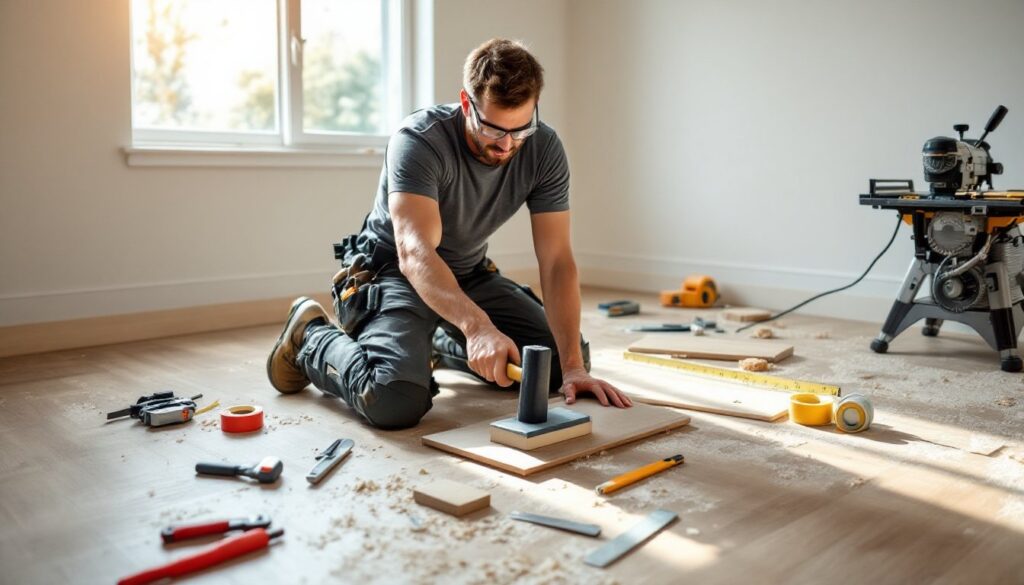
A pull bar (also called a flooring pry bar) is non-negotiable for closing gaps between planks, especially on the last row where you can’t swing a mallet. Pair it with a tapping block to protect plank edges when you’re knocking tongue-and-groove flooring into place. For laminate and engineered wood, these two tools do most of the heavy lifting during assembly.
You’ll also need a utility knife with fresh blades for scoring vinyl and trimming underlayment, a chalk line for snapping reference lines across long runs, and a carpenter’s square to check that your starting row sits perfectly perpendicular to the longest wall. A contour gauge copies the profile of door casings and trim so you can transfer exact shapes onto planks for scribing cuts.
Don’t skip a quality pry bar and hammer for removing baseboards and shoe molding. Trying to reuse trim without damaging it requires patience and the right leverage. A rubber mallet is gentler than a steel hammer for tapping pieces together without denting edges.
Measuring and Layout Tools
Accurate measurement prevents expensive mistakes. Start with a 25-foot tape measure, anything shorter won’t span most rooms in one pull. For large spaces, a laser distance measurer speeds up the process and eliminates math errors when calculating square footage or diagonal measurements to check for square.
A T-square or speed square keeps crosscuts accurate when marking planks. Many installers also rely on a framing square to verify room corners: most rooms aren’t perfectly square, and knowing your variance upfront lets you plan where to hide tapers and adjustments.
A pencil and carpenter’s pencil are obvious but worth mentioning, mark on the subfloor, not just the flooring surface, so layout lines survive the shuffle of materials. Some pros prefer a mechanical pencil for fine scribing work on planks.
Power Tools That Make Flooring Installation Easier
Power tools turn a multi-day grind into a manageable weekend project. The right saw makes all the difference. A miter saw (10-inch or 12-inch) is ideal for crosscuts and angled cuts on hardwood, laminate, and engineered flooring. For rip cuts along the length of planks, a table saw delivers straight, repeatable results, though a circular saw with a guide works if you don’t have shop space. When working with luxury vinyl tile (LVT) or vinyl plank, a specialized flooring saw handles the material without chipping.
For solid hardwood installation, a pneumatic flooring nailer is the standard. These come in two styles: cleat nailers (for ¾-inch solid wood) use L-shaped fasteners, while finish nailers work for thinner engineered products. Both require an air compressor, a 6-gallon pancake compressor running at 90–120 PSI handles most nailers just fine. Staple guns are another option for engineered wood, but nailers give better holding power on solid stock.
If you’re installing tile or stone, a wet tile saw with a diamond blade is essential for clean cuts without cracking. Budget saws start around 7 inches: 10-inch models handle larger-format tile.
A jigsaw is your go-to for curved cuts around toilets, door casings, and heat registers. Pair it with a fine-tooth blade for laminate to minimize chipping on the face. An oscillating multi-tool undercutting door jambs so flooring slides underneath, beats trying to scribe and notch every plank that meets a doorway.
Don’t forget a drill/driver for securing transitions, thresholds, and any subfloor repairs. A corded model delivers consistent power, but an 18V cordless offers enough torque for most fastening tasks.
Specialty Tools for Different Flooring Types
Different flooring materials demand different tooling. Installing luxury vinyl plank (LVP) or luxury vinyl tile (LVT)? A vinyl cutter (also called a guillotine cutter) makes fast, dust-free cuts without power. It’s not essential, you can score and snap with a utility knife, but it speeds up the job and reduces wrist fatigue on large installs.
For solid hardwood or engineered wood, a flooring roller (100 pounds minimum) ensures glue-down planks make full contact with adhesive. Rent one if you’re not installing flooring regularly. Nail-down installations need a mallet specifically weighted for the nailer you’re using, too light and fasteners don’t seat: too heavy and you risk denting tongues.
Tile and stone installations require a notched trowel sized to your tile (larger tile needs deeper notches for proper mortar coverage). You’ll also want tile spacers, a grout float, and a margin trowel for mixing and detail work. A tile leveling system (clips and wedges) keeps lippage to a minimum on large-format tile, cheap insurance against an uneven surface.
If you’re laying carpet, that’s a whole separate trade with its own toolkit: knee kicker, power stretcher, carpet trimmer, and seaming iron. Carpet installation isn’t as DIY-friendly as hard-surface flooring, and most homeowners are better off hiring it out unless they’ve done it before.
For bamboo or cork, which are sensitive to moisture, a moisture meter is smart prep. Subfloor moisture above 12% will cause problems down the road. This same tool is useful for any wood product, it helps you confirm material has acclimated to the room before installation.
Safety Equipment and Protective Gear
Flooring work is physically demanding and filled with opportunities to hurt yourself. Proper personal protective equipment (PPE) isn’t optional.
Start with knee pads. Not the cheap foam kind, get a pair with hard caps and gel cushioning. You’ll spend hours on your knees during installation, and blown knees aren’t worth the savings. Many installers prefer kneeling pads (foam mats) for glue-down work where you’re shifting position constantly.
Safety glasses are mandatory anytime you’re cutting. Flying wood chips, vinyl shards, and tile fragments can cause permanent eye damage. If you’re running a wet saw, get glasses with anti-fog coating or a face shield to block spray.
A dust mask (N95 or better) protects your lungs when cutting MDF-core laminate, which releases fine particles, or any cement backer board for tile. For extended work, consider a respirator with replaceable filters, especially important if you’re sanding or working with adhesives that off-gas VOCs.
Hearing protection is necessary with miter saws, circular saws, and especially pneumatic nailers, which produce sharp, repetitive noise that damages hearing over time. Foam earplugs work, but earmuffs are more comfortable for all-day wear.
Work gloves protect hands when handling rough-cut lumber, sheet goods, or tile. Choose a style with grip on the palms, you want dexterity, not bulk. When mixing thinset or adhesive, switch to chemical-resistant gloves to avoid skin irritation.
Finally, wear steel-toe boots. Dropped tools, materials, and equipment are common, and a smashed toe will shut down your project fast. Boots with slip-resistant soles also help on dusty subfloors.
Building Your Flooring Tool Kit: What to Buy vs. Rent
Not every tool justifies the purchase price, especially for a one-time project. Here’s how to split the decision.
Buy these: Measuring tools (tape measure, square, chalk line), hand tools (utility knife, tapping block, pull bar, pry bar, hammer, rubber mallet), and basic safety gear (knee pads, safety glasses, dust masks). These are inexpensive, versatile across many home improvement tasks, and will serve you on future projects. A decent miter saw is also worth owning if you do any carpentry or trim work. Entry-level 10-inch models start around $150 and handle most DIY flooring cuts.
If you’re serious about DIY and plan to tackle multiple rooms or help friends, a finish nailer and small air compressor are solid investments. Together they’ll run $250–$400, but they’re useful for installing baseboards, crown molding, and trim beyond flooring.
Rent these: Flooring nailers (pneumatic cleat or staple models), table saws, wet tile saws, flooring rollers, and any specialty equipment like carpet stretchers or vinyl plank cutters. Rental rates typically run $40–$80 per day, and most home centers offer weekend packages. Renting prevents dropping $500+ on a tool you’ll use once.
For a typical 300-square-foot room in engineered hardwood, you might rent a flooring nailer and compressor for a weekend ($100 total) while using your own miter saw, hand tools, and measuring devices. That’s far cheaper than buying a nailer you’ll store for years between uses.
One more consideration: if you’re installing flooring in a workshop space or garage, durability and equipment compatibility matter, those environments see heavier abuse than residential rooms, and the same workshop tools you rely on for other projects can often double as installation aids.
Some home improvement resources like This Old House and Fix This Build That offer detailed tool reviews and project walkthroughs that can help you decide what’s worth the investment. Pay attention to whether a tool fits your broader project pipeline, not just the floor in front of you.
Conclusion
The right tools won’t install the floor for you, but they’ll make the job straighter, faster, and a whole lot less frustrating. Invest in quality hand tools and safety gear, rent the heavy hitters, and don’t cheap out on blades or fasteners. Measure twice, cut once, and give yourself time to do it right, rushing a floor install just means you’ll be staring at the mistakes for years.